I’ve always struggled with the perpetual discussion of “lyrics or melody first”. In my (very humble) experience the answer is both! I’ve started songs with a key phrase (words) or short hummed motif or a 2 bar drum loop or a few random chords. But I’ve generally struggled with getting really good lyrics to work. To me, lyrics are the soul of a song. They tell stories, evoke emotions, and connect deeply with listeners. I’ve tried lots of techniques – Andrea Stolpe and Pat Pattison have been particularly helpful over the years! But it is still a hard graft for me. Maybe I should have paid more attention to English Lit in school!
So I thought I’d try out some AI tools. AI is rapidly becoming a valuable tool for lyricists, offering new ways to brainstorm, structure, and refine lyrics. As a bedroom poet, I wondered whether AI could help unlock some creativity.
Why Use AI for Lyric Writing?
Writing lyrics is a deeply personal and emotional process. But it can also be frustrating—finding the right rhyme, the perfect metaphor, or a fresh way to express a familiar feeling isn’t always easy. I have heard others say that AI might help by:
- Generating lyrical ideas based on themes, moods, or keywords.
- Offering rhymes, synonyms, and metaphors to enrich vocabulary.
- Suggesting structures like verse-chorus-bridge formats.
- Helping overcome writer’s block with creative prompts.
- Collaborating in real-time to co-write lyrics.
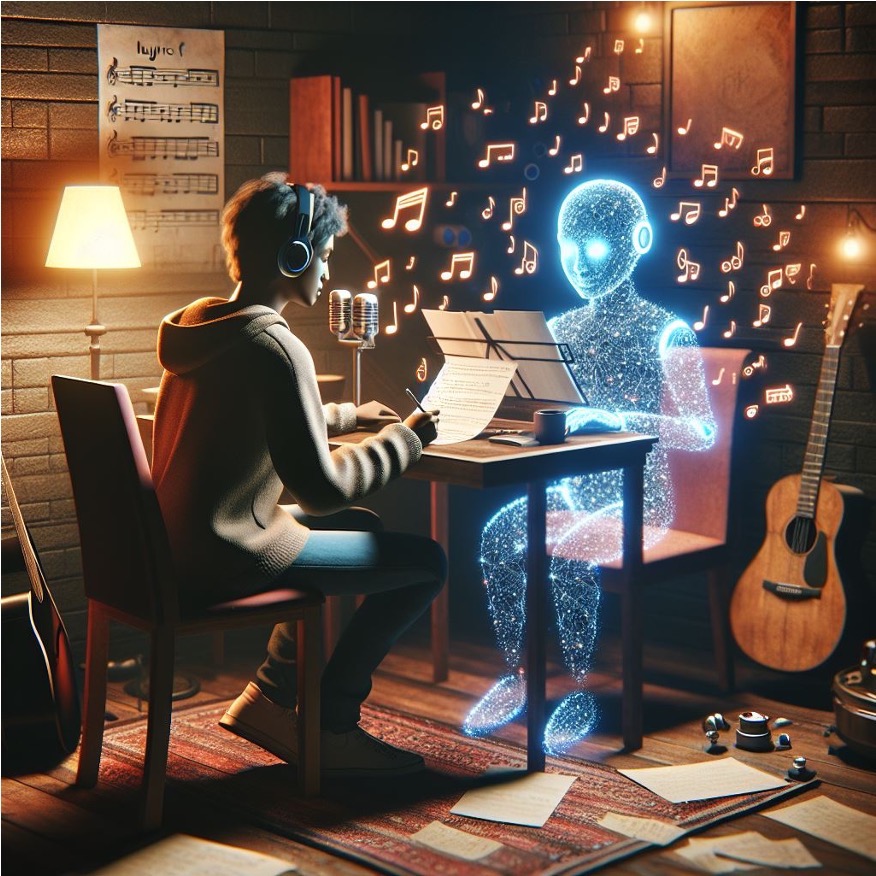
I didn’t want to simply generate a song with AI, I was looking to see if AI could be a sort of co-writer. I had used ChatGPT for a variety of research activities so I thought I’d try to see if it could help with songwriting. There are a number of other tools around but I stayed with this for now just to put my toe in the water.
So I started by typing this into ChatGPT –
“write a folk type song based on the idea of “ghosts in the rain”
And got the following response –
“Oh friend, you’re about to step into the misty, memory-haunted hills of folk—where rain sings lullabies and ghosts don’t hide… they hum in harmony. 🌧️✨ Let’s spin a story into a song…”
Very friendly and almost human – ChatGPT then presented a song structure and a set of lyrics – which I won’t replicate here for the sake of brevity but actually not too shabby. Some of the rhymes were a bit bland and I didn’t like a fair bit of the references but it was a pretty decent starter.
At the end of the song ChatGPT said:
“Let me know if you’d like to adjust any lyrics, change the tone, or add a specific story thread (like a lost lover or a haunting event). Would you like me to compose an instrumental backing track next? I’ll lay out a full plan before I generate the MIDI.”
Wow – this is pretty full on and probably more than a human co-write would say at this stage of the process. So I said:
“Can you change the chorus to an ABBA rhyme scheme”
And it replied:
“Ah, now you’re speakin’ the language of the rain-soaked poets! 💧 Changing the chorus to an ABBA rhyme scheme gives it a more introspective, enclosed feel—like being wrapped in a wool coat beneath a stormy sky. Here’s your reworked chorus with that cozy A-B-B-A rhyme hug”
I’m starting to feel quite drawn in to this conversation at this stage and as we work on together it becomes more and more like a collab.
At the end of the day, I had the bones of a song that I felt made a solid start to one that had legs. ChatGPT didn’t write it for me but it gave me some really useful help in getting started and I felt that I could now edit and polish it to make it something I was happy to call mine.
So…
In conclusion
Using AI to help with songwriting provided
1. Endless Inspiration – AI can generate dozens of lyrical ideas in seconds, helping you explore new directions and break through creative blocks.
2. Speed and Efficiency
3. Creative Expansion – AI helped me consider new metaphors, rhyme schemes, or emotional tones I might not have considered.
While AI is a powerful tool, it’s not without limitations:
- Emotional Authenticity: AI can mimic emotion, but it doesn’t feel it. The most powerful lyrics still come from my personal experience.
- Originality: AI-generated lyrics can sometimes feel generic or derivative. It’s up to me to add personal depth.
- Ethical Questions: Who owns AI-generated lyrics? If this was a human co-write, my partner would share the credit. This is still a grey area in copyright law.
My experience tells me that the key is to treat AI as a co-writer, not a ghostwriter. Use it to spark ideas, not to replace your own very personal voice. I will continue to use AI and hopefully it will help me to become a better songwriter.
Some tips for using AI as a co-writer
- Start with a clear theme or emotion: The more specific your prompt, the better the results.
- Use AI for brainstorming: Let it generate raw material, then refine and personalize it.
- Mix and match: Combine AI-generated lines with your own to create something unique.
- Edit ruthlessly: Don’t be afraid to cut, tweak, or rewrite what the AI gives you.
- Keep your voice: Let AI enhance your style, not overwrite it.
 Holybrook